UTP, FTP and SFTP: choosing shielding for the site, not for the datasheet
What does each abbreviation mean?
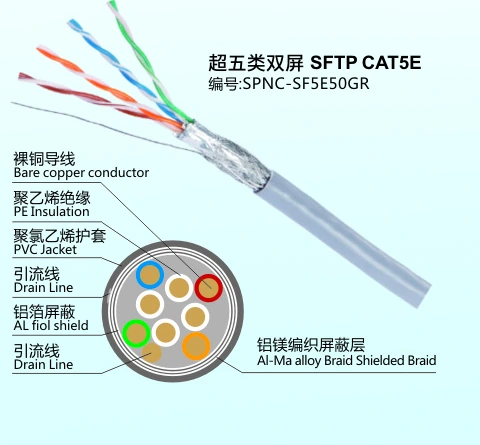
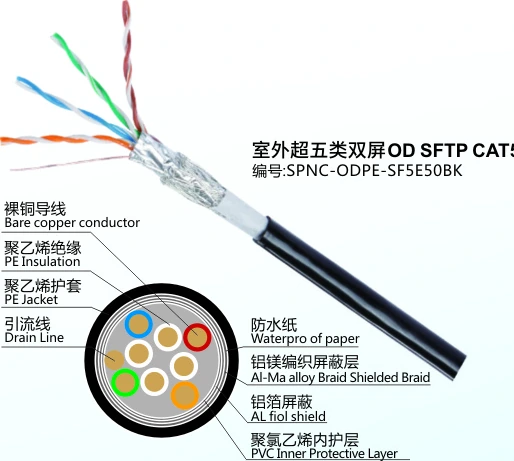
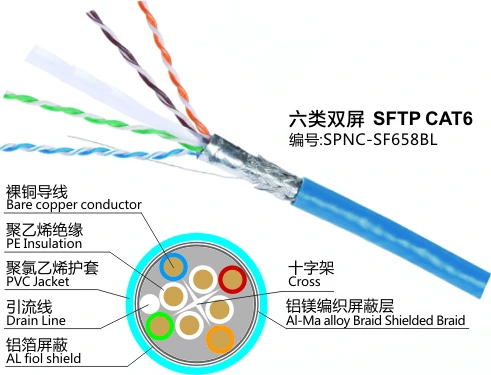
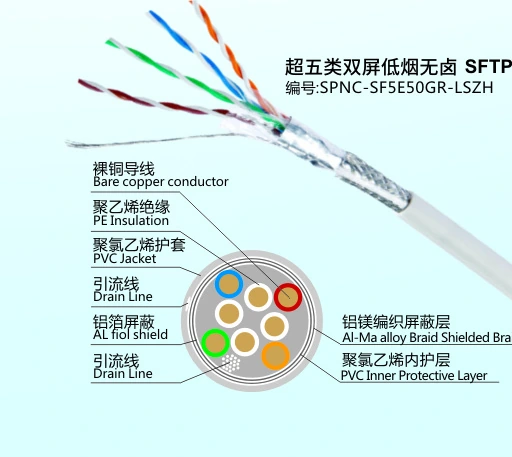
UTP is unshielded twisted pair: four twisted pairs and nothing else. FTP (also written F/UTP) wraps the whole cable in aluminium foil with a drain wire. SFTP (S/FTP) combines foil around each pair with an overall braid. SSTP screens the entire cable, and our CAT7 is built this way.
The construction notes show exactly this: the unshielded CAT5E lists conductor, insulation and jacket; the FTP version adds aluminium foil and a drain line; the SFTP version adds foil plus an Al-Mg alloy braid and a ground wire.
When does shielding actually help?
Shielding helps when there is an external electromagnetic field the pairs would otherwise pick up: variable-frequency drives, welding plant, lift machinery, large transformers, long parallel runs beside power cable. It also reduces how much the cable itself emits, which matters in sensitive environments such as hospitals and test laboratories.
It does not help with alien crosstalk between neighbouring cables in a bundle — that is a geometry and separation problem, and it is why high-category shielded cable is often specified in dense trays.
When does shielding make things worse?
When the shield is not bonded. A floating foil acts as an antenna: it couples noise onto the cable instead of draining it away. The drain wire has to reach an earth point at the patch panel, and the outlet has to maintain the screen connection through to the equipment.
That is why a shielded cable installed by a contractor who has not been told to bond it performs worse than the unshielded cable it replaced — and why the failure is usually reported as a cable fault rather than an installation fault.
What does the installer have to do differently?
Bond the drain at the panel end, keep the foil continuous when stripping, use shielded outlets and shielded patch cords, and keep the bend radius generous. Also expect a heavier, stiffer cable: shielded CAT6A is harder to pull through tight containment than unshielded CAT6.
If the installer cannot guarantee all four, the honest recommendation is unshielded cable in metal containment.
How do I decide per project?
Ask three questions: what is the cable route, who is doing the termination, and what does the customer's specification actually say. If the route crosses plant equipment and the installer is certified for shielded work, shield it. If the route is a clean office ceiling and the installer is not, do not.
For quotes, keep both versions in the price list. Our part numbers make that easy: SPNC-U5E50GR and SPNC-F5E50GR are the same category and jacket family, one shielded and one not, so the customer sees the delta directly.
Frequently asked
Is SFTP better than FTP?
Double shielding gives more coverage, but it also adds cost, weight and installation risk. FTP is usually enough where the interference is moderate; choose SFTP where the environment is genuinely noisy or the customer specifies it.
Can shielded and unshielded cable be mixed in one installation?
Electrically yes, but the channel test is only as good as its weakest link. Keep a channel consistent — mixing shielded and unshielded segments makes the shield ineffective and the documentation wrong.
Do I need shielded patch cords with shielded cable?
Yes. The screen has to be continuous from the panel to the equipment, so the cord must be shielded and its plug must bond to the outlet screen.
Does shielding change the data rate?
No. The category sets the bandwidth; the shield changes immunity and emissions. A shielded CAT5E is still a 100 MHz cable.
Need the actual part numbers?
The product pages carry the full specification for every item.