Outdoor network cable: what ODPE changes, and when it is the wrong choice
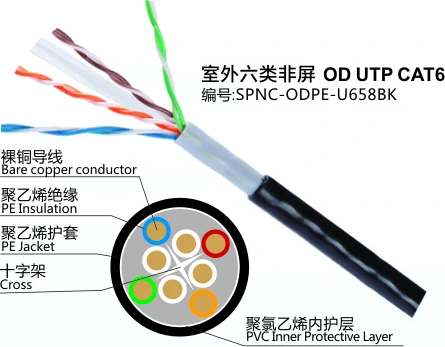
Outdoor cable is a different construction, not a different colour
The jacket on an indoor cable is PVC. Put it in a duct for two summers and the plasticiser migrates, the jacket hardens and cracks, and water finds the shield. The outdoor version changes the compound — polyethylene instead of PVC — and usually adds a water-blocking layer under it.
In our range those items carry ODPE in the part number, for example SPNC-ODPE-U658BK against the indoor SPNC-U658GR. Same category, same electrical block, different jacket and different part number, because the two are not interchangeable in a tender.
What the water-blocking layer does
A water-blocking tape or yarn sits between the core and the jacket. If the jacket is damaged — rodent, spade, expansion joint — the block swells and stops water travelling along the cable. Without it, a single nick at a low point can fill 30 m of duct.
This matters most on horizontal runs between buildings, where the cable is the only thing between two water tables and there is no way to inspect it afterwards.
UV, temperature and the reel that sits outside
PE resists UV far better than PVC, which is why the outdoor construction is also the one to specify when cable is stored on site for weeks before installation. A reel left in the sun is a real installation condition, not a theoretical one.
The same logic applies to temperature range: an outdoor cable in a duct in Guangdong sees a much hotter environment than a plenum ceiling, and the current-carrying limits for PoE fall accordingly. If a customer is running PoE to a pole-mounted camera, check the conductor size and the distance together.
When outdoor cable is the wrong answer
Three common cases. First, an aerial span between buildings: no jacket compound replaces a messenger wire and proper strain relief, and a sagging span will fail at the clamp long before the jacket fails.
Second, direct burial: ODPE is not armour. If the route is buried without a duct, specify an armoured or steel-tape construction — we do not list one in this range, and saying so is more useful to the customer than quoting a jacket that will be cut by a shovel.
Third, an interior run to a facade penetration: the fire strategy usually requires LSZH inside the building envelope. Splice from the outdoor cable to an LSZH indoor construction at the entry point rather than running PE cable into a ceiling void.
Ordering the pair correctly
A clean outdoor job is specified as two part numbers with a transition point: the ODPE construction outside, an LSZH or PVC construction inside, and a proper entry seal where they meet. That is also the cleanest way to quote it, because the customer can see exactly where the specification changes.
If both ends of the run are outside and the environment is aggressive, ask for the cable in the longest practical reel length — every splice outdoors is a future fault, and the factory can wind to your length.
Frequently asked
What does ODPE mean in a part number?
ODPE marks the outdoor PE-jacketed construction of the same cable family, for example SPNC-ODPE-U658BK against the indoor SPNC-U658GR.
Can I use outdoor cable indoors?
Physically yes, but it usually fails the fire strategy: PE jackets are not LSZH. Transition to an indoor construction at the building envelope.
Do you make armoured cable?
The specification in this range does not list an armoured construction. For direct burial without a duct, tell us the route and we will say what we can supply rather than substitute a jacket.
Is the electrical performance the same as the indoor version?
The specification states one electrical block per family — 100 ± 15 ohm, ≤ 9.38 ohm/100 m at 20 °C, ≤ 5.6 nF/100 m — and the ODPE items belong to the same family. The difference is the jacket and the water block.
Need the actual part numbers?
The product pages carry the full specification for every item.