LSZH or PVC: when the jacket material changes the specification
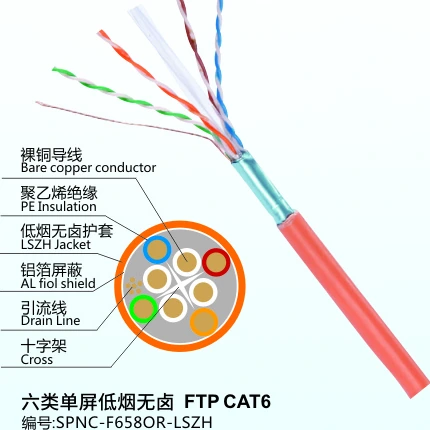
What does LSZH actually mean?
Low smoke zero halogen means the jacket compound contains no halogens (chlorine, bromine, fluorine) and is formulated to produce less smoke and less corrosive gas when it burns. PVC, the default jacket material, contains chlorine and gives off hydrogen chloride in a fire — which is why PVC cable is restricted in enclosed public spaces in many jurisdictions.
The trade-off is mechanical: LSZH compounds are usually harder to process and slightly less flexible than PVC, and they cost more. That is the whole reason both exist.
Where is LSZH required?
Typically in escape routes, stairwells, risers serving public areas, tunnels, hospitals, schools, airports, data centres with suppression systems, and anywhere the local code or the client's fire strategy names it. The requirement is usually written into the project specification rather than chosen by the installer.
If the specification is silent, ask the fire consultant rather than guessing. The cost difference per metre is small compared with re-pulling a riser.
Does LSZH change the electrical performance?
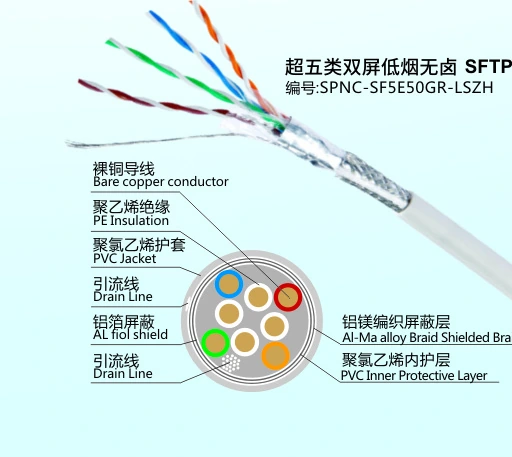
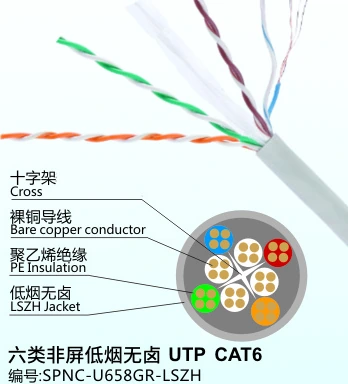
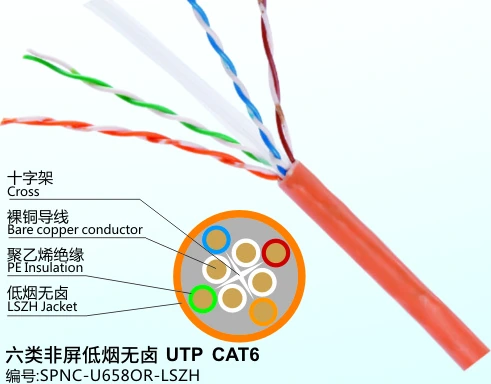
No. The conductor, insulation, shield and pair geometry stay the same; only the jacket compound changes. Our LSZH versions keep the same electrical limits as the PVC equivalents — 100 ± 15 ohm impedance, 9.38 ohm per 100 m maximum conductor resistance and the same capacitance limits.
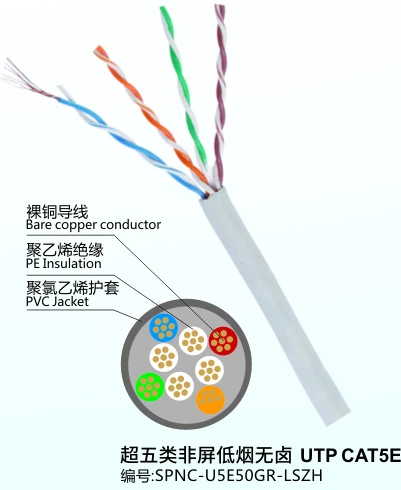
What does change is the part number. Every LSZH variant on this site carries the -LSZH suffix, so SPNC-U5E50GR becomes SPNC-U5E50GR-LSZH. Keeping that convention in your own documentation avoids the most common ordering error in this category.
What about smoke and toxicity testing?
LSZH is a material property, not a test certificate. Projects that require a specific fire performance will name a test standard and a class, and the cable has to be certified to it. Our range publishes the construction and the electrical specification; the fire classification for a given order is confirmed with the quotation.
That distinction matters when you are quoting: do not describe a cable as "fire rated" unless you have the certificate in hand for that part number.
How do I switch an existing project to LSZH?
Change the jacket, keep everything else. The same category, shield and colour are available with an LSZH jacket, so the channel design does not move — only the part number and the price.
Then check two knock-on items: the outlets and patch cords (they should be the same material family for a consistent fire story) and the client's documentation, which usually lists jacket material per cable.
Frequently asked
Is LSZH cable more expensive?
Yes, typically a modest premium over PVC for the same construction. Ask for the quote per part number rather than estimating from a percentage, because the delta varies with category and jacket thickness.
Can LSZH cable be used outdoors?
Outdoor cable is normally PE jacketed for UV and water resistance, not LSZH. The two requirements usually conflict, so specify the outdoor construction for exterior runs and LSZH for interior routes.
Does LSZH cable have a shorter service life?
There is no shorter service life implied by the material. What matters is installation: LSZH jackets are less tolerant of sharp bends and abrasion during pulling.
Are LSZH patch cords available?
Yes — for example NP6A716A015-LSZH for CAT6A and NP7ST716A015-LSZH for CAT7, so the cord matches the horizontal cable.
Need the actual part numbers?
The product pages carry the full specification for every item.