CAT5E, CAT6, CAT6A and CAT7: what actually changes between them
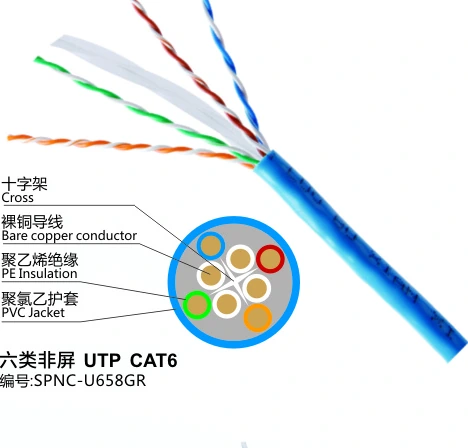
What do the category numbers actually mean?
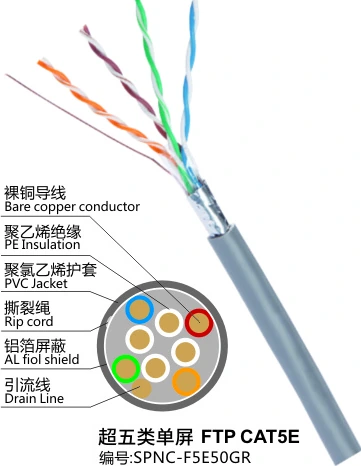
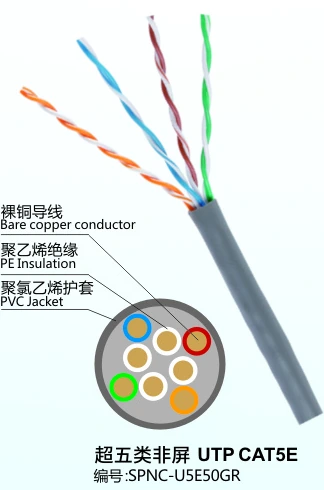
The category number is a bandwidth class, not a marketing tier. It tells you the frequency the cable is designed to carry: CAT5E is specified to 100 MHz, CAT6 to 250 MHz, CAT6A and CAT7 to 500 MHz, and CAT8 to 1000 MHz. The data rate follows from that bandwidth and from the coding the switch uses.
Our own specification states the relationship plainly: CAT5E runs at 100 Mbps over 100 MHz, CAT6 at 1000 Mbps over 250 MHz, CAT6A and CAT7 at 10 Gbps over 500 MHz, and CAT8 at 50 Gbps over 1000 MHz. If you are quoting a job, that table is the one to hand your customer — everything else in the category discussion is a consequence of it.
Does CAT6 need the spline, and CAT6A the shield?
CAT6 cable adds a PE cross filler between the pairs. The filler keeps the four pairs in a fixed geometry, which is what makes the higher frequency testable — it is a mechanical solution to an electrical problem, and it is why CAT6 cable is stiffer and slightly larger than CAT5E.
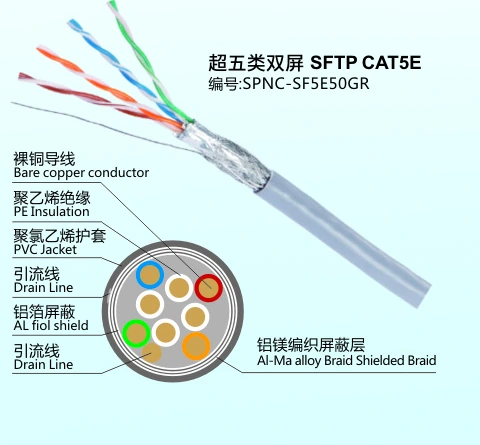
CAT6A does not have to be shielded, but in practice most CAT6A cable sold is F/FTP or S/FTP because alien crosstalk between adjacent unshielded cables becomes the limiting factor at 500 MHz. CAT7 is defined as a shielded construction — our CAT7 is an SSTP cable with foil and braid and an LSZH jacket.
If the customer asks for CAT7, should I sell CAT7?
Only with a reason. CAT7 is not a TIA/EIA category; it is an ISO/IEC class (F) and its connector interface is not the same as what most RJ45 patch panels provide. If the customer's rack is filled with RJ45 hardware, a well-installed CAT6A channel will meet the same design goal with far fewer installation risks.
CAT7 makes sense in two cases: the customer has a contractual requirement written around ISO/IEC 11801 Class F, or the environment is electrically noisy enough that the braided shield is doing real work. In both cases ask who is bonding the shield, because an unbonded shield is a liability.
How much does the category change the installation cost?
Beyond the cable price, three things scale with category: bend radius (stiffer cable, wider bends), containment fill (larger diameter), and test equipment (a 500 MHz certifier costs more than a 100 MHz one). A CAT6A job also usually moves the outlets, patch panels and patch cords to shielded versions, so the channel — not just the reel — changes.
When you quote, price the whole channel: cable, outlets, patch panel, patch cords and certification. A cheap reel in an under-specified channel is the most common reason a job fails its handover test.
What about CAT8?
CAT8 is a short-reach cable: it is intended for 25G and 40G links inside a rack or between adjacent racks, typically up to 30 m, and it is always shielded. It is not a replacement for CAT6A in horizontal cabling — the length limit makes that impossible.
Our CAT8 assembly, NP8T718A015, is sold as a terminated patch cord for exactly that use: short switch-to-server links where the bandwidth is needed and the run is short.
How do I keep the channel consistent once I have chosen?
Buy the patch cords from the same production as the cable. The impedance and resistance limits — 100 ± 15 ohm and 9.38 ohm per 100 m at 20 °C in this range — apply to the whole channel, and a cord from a different supplier is the easiest way to lose them without noticing.
Then label everything by category at the reel, the box, the panel and the cord. In a mixed estate, the failure is almost never a bad reel; it is a CAT5E cord on a CAT6A port.
Frequently asked
Is CAT6 cable enough for 10GBASE-T?
CAT6 can carry 10GBASE-T up to about 55 m in good conditions, but the design limit for a full 100 m channel is CAT6A. If the customer expects 10 Gbps to the desk over a full-length run, specify CAT6A.
Do I need shielded cable for a data centre?
Not automatically. Shielded cable helps where the environment is noisy or where the customer requires it. It only works if the shield is bonded at both ends, so in cabinets with plastic managers an unshielded CAT6A cord is often the safer specification.
Are LSZH jackets available in every category?
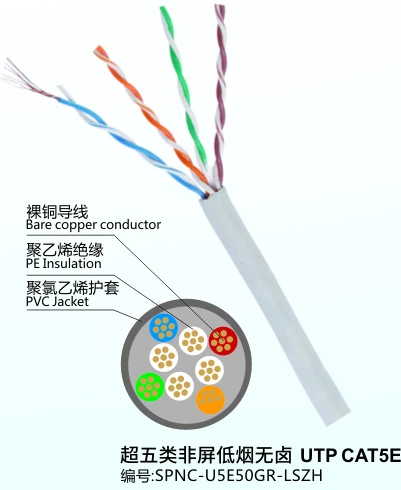
Yes. Every network cable family on this site has an LSZH variant identified by the -LSZH suffix, from CAT5E up to CAT7 SSTP.
Which category should I stock for general distribution?
CAT6 unshielded covers the largest share of commercial fit-outs, with CAT5E for refurbishment and CAT6A for projects that specify 10 Gbps to the desk. Hold small quantities of LSZH variants for public buildings.
Need the actual part numbers?
The product pages carry the full specification for every item.