CCTV and video surveillance
Analogue camera systems still run on coaxial cable, and hybrid installations need the control and power cores in the same trench.
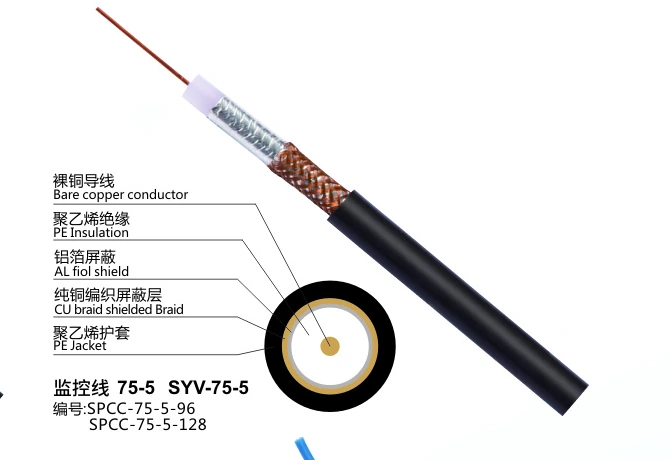
Coaxial cable: why 75 ohm and braid count decide picture quality
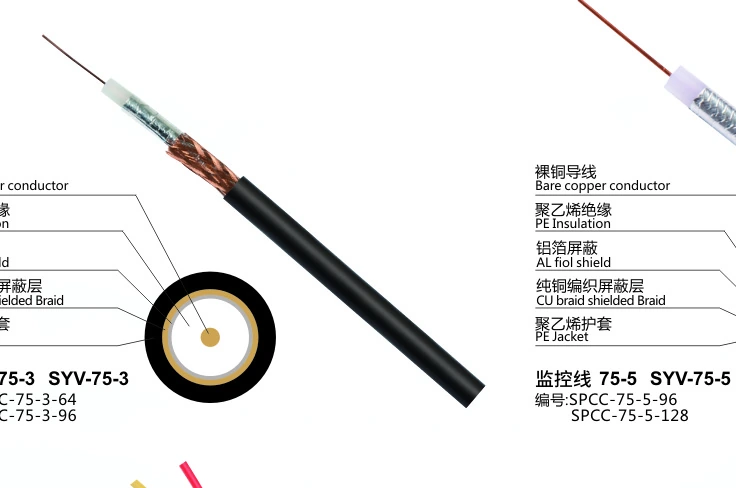
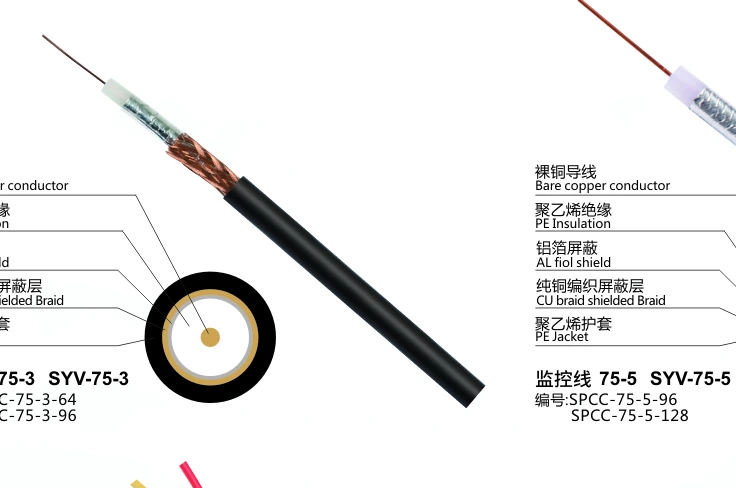
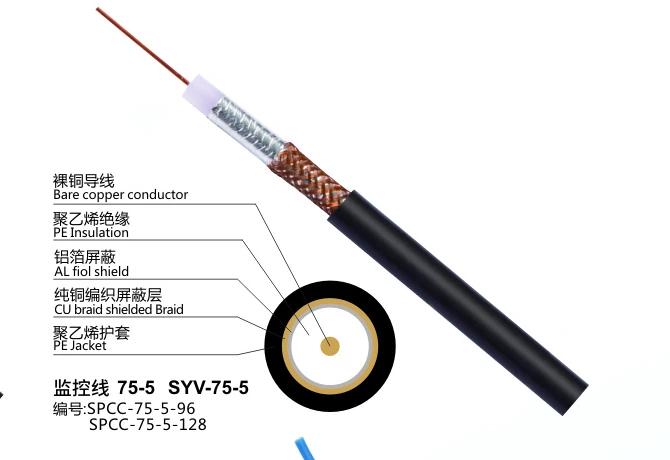
SYV cable is a 75 ohm coaxial construction: a single solid bare copper conductor, physical foam polyethylene insulation, aluminium foil and a tinned copper braid, all under a PVC jacket. The impedance match between camera, cable and recorder is what keeps the video signal clean; a cable that drifts away from 75 ohm shows up as loss of contrast and colour shift at the far end of the run.
The two numbers in our part numbers — 64, 96 or 128 — are braid strand counts. For SYV-75-3 the range is 64 and 96 strands, for SYV-75-5 it is 96 and 128. Higher braid count means better shielding coverage, which matters where the cable shares a tray with mains power or runs near switching equipment.
Power and control cores
Camera power and PTZ control are usually carried on flexible RVV or RVVP cable: bare copper conductors, PE insulation and a PE jacket, with foil and braid shielding on the RVVP versions. The shielded variant is the right choice for control lines that run alongside power, because the same interference that spoils video will also produce phantom PTZ commands.
Because these cables are flexible, they are also the practical choice for the short drops inside a camera housing and for pole-mounted junction boxes where a solid-core cable would fatigue.
Designing the run
Keep the coaxial run as short as the site allows and remember that braid coverage, not cable diameter alone, drives the shielding performance. Where the site is converting to IP cameras, the same duct can carry CAT6 with PoE and the coaxial cable can be left as a spare path — which is why many integrators order both families from one supplier and label them in the same documentation set.
Outdoor runs need the PE-jacketed, waterproof-paper constructions rather than indoor PVC. If the cable enters a building, plan the transition at the wall rather than running an indoor cable into the weather.
What to send with an enquiry
Tell us the camera count, the average and maximum run length, whether power is local or centralised, and whether the cable will share containment with mains. From that we recommend SYV-75-3 or 75-5 with the appropriate braid count, plus the RVV/RVVP cores for power and control.